Citation-based impact indicators, like the ones calculated by scholarly platforms, can provide valuable context about research works and researchers. In many cases, it is useful to display such indicators directly on the websites where these works and researchers are presented: software registries, project pages, institutional repositories, lab websites, or personal academic homepages.
For BIP! Services, we calculate a rich set of impact indicators for more than 284M research works, covering different aspects of scientific impact, such as popularity, influence, and impulse. To make it easy for anyone to integrate these indicators into their own web pages, we offer BIP! Badges.
Paper-level badges have been available for quite a few months now, and they were recently joined by the release of researcher-level badges. With this blog post, we take the opportunity to present both types of badges together.
What are BIP! Badges?
BIP! Badges is a lightweight JavaScript library that displays interactive badges visualising the citation-based impact indicators of research works and researchers. The badges are powered by the BIP! Services, so they always reflect the indicators calculated on top of the BIP! citation network, which is built primarily from data of the OpenAIRE Graph.
Any website that mentions a publication or a researcher can show, right next to it, a compact and visually appealing summary of the corresponding indicators. Visitors get valuable context at a glance, without having to leave the page, and since the badges are interactive, they can explore the indicators in more detail directly from the badge itself.
In line with all our other tools, the library is open source and free to use.
Badges for Publications and for Researchers
BIP! Badges currently cover two levels at which impact is usually discussed:
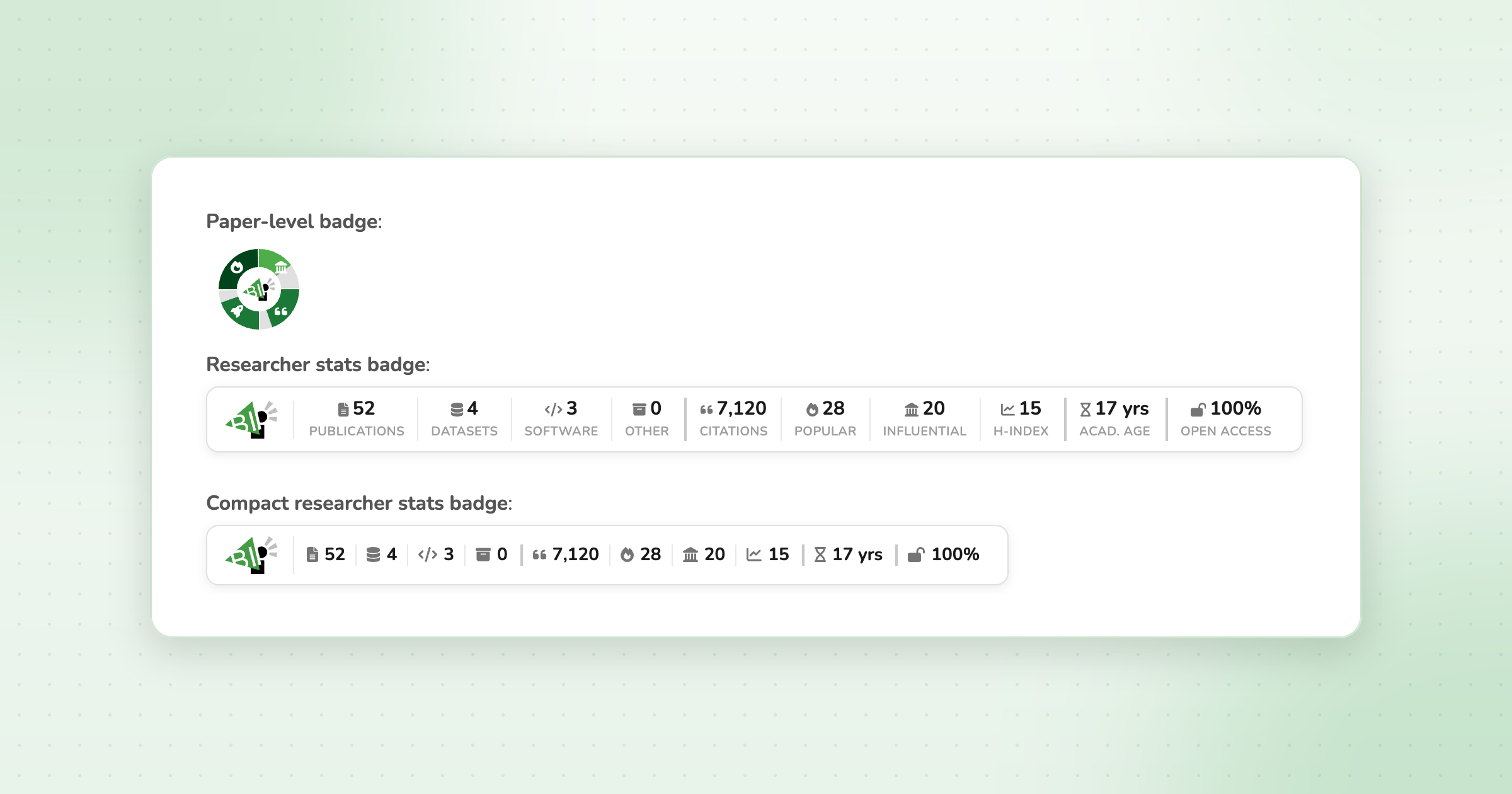
- Paper-level badges visualise the indicators of a single research work, identified by its DOI. These include the BIP! impact indicators that capture different aspects of impact, such as popularity (the current attention a work receives), influence (its overall, long-term impact), and impulse (its initial momentum right after publication), along with its citation count. Following our usual practice, indicators are presented together with the corresponding impact classes (e.g., top 1% or top 10%), which are much easier to interpret than raw scores.
- Researcher-level badges summarise indicators at the researcher level, aggregating information across a researcher’s whole body of work, similarly to what is shown in BIP! Scholar profiles. They come in two variants: a full researcher stats badge, and a compact researcher stats badge that offers the same information in a smaller footprint, ideal for sidebars, author lists, or team pages where space is limited.
Two Lines of Code, Zero Infrastructure
We designed BIP! Badges so that anyone who can edit an HTML page can use them, without setting up servers, handling API calls, or storing any data. Embedding a paper-level badge takes two simple steps:
1) Include the library in your page:
<script src="https://cdn.jsdelivr.net/gh/athenarc/bip-plugin@main/embed.min.js"></script>2) Add an element with the bip-embed class wherever you want a badge to appear, specifying the DOI of the work:
<div class="bip-embed" data-doi="10.1093/nar/gkx1141"></div>That’s it! The library takes care of fetching the indicators and rendering the badge. You can place as many badges as you like on the same page; each one automatically retrieves and displays the data for its own DOI.
Researcher-level badges are embedded in an equally simple way; detailed instructions for all badge types are available in the quick start guide of the library’s repository.
Already in Action: the bio.tools use case
BIP! Badges are not just a proof of concept. bio.tools, the ELIXIR registry of bioinformatics software tools, already integrates a BIP! badge for each of the related publications of every software tool entry.
This is a nice example of how badges can add value to a third-party service. A researcher browsing bio.tools to choose a tool can now immediately see how the publications related to that tool are performing in terms of citation-based impact indicators. And all of this was achieved by the bio.tools team without having to build and maintain their own indicator calculation pipeline.
Looking Ahead
We are continuously working on improving the badges and extending them with new features. If you integrate BIP! Badges into your website, we would love to hear about it! Feel free to reach out to us, or open an issue in the GitHub repository with your feedback and suggestions.
Interested in trying them out? Visit the BIP! Badges section of our Data & Code page to see examples of all badge types.
|
Blog post DOI: https://doi.org/10.5281/zenodo.23620862 |